

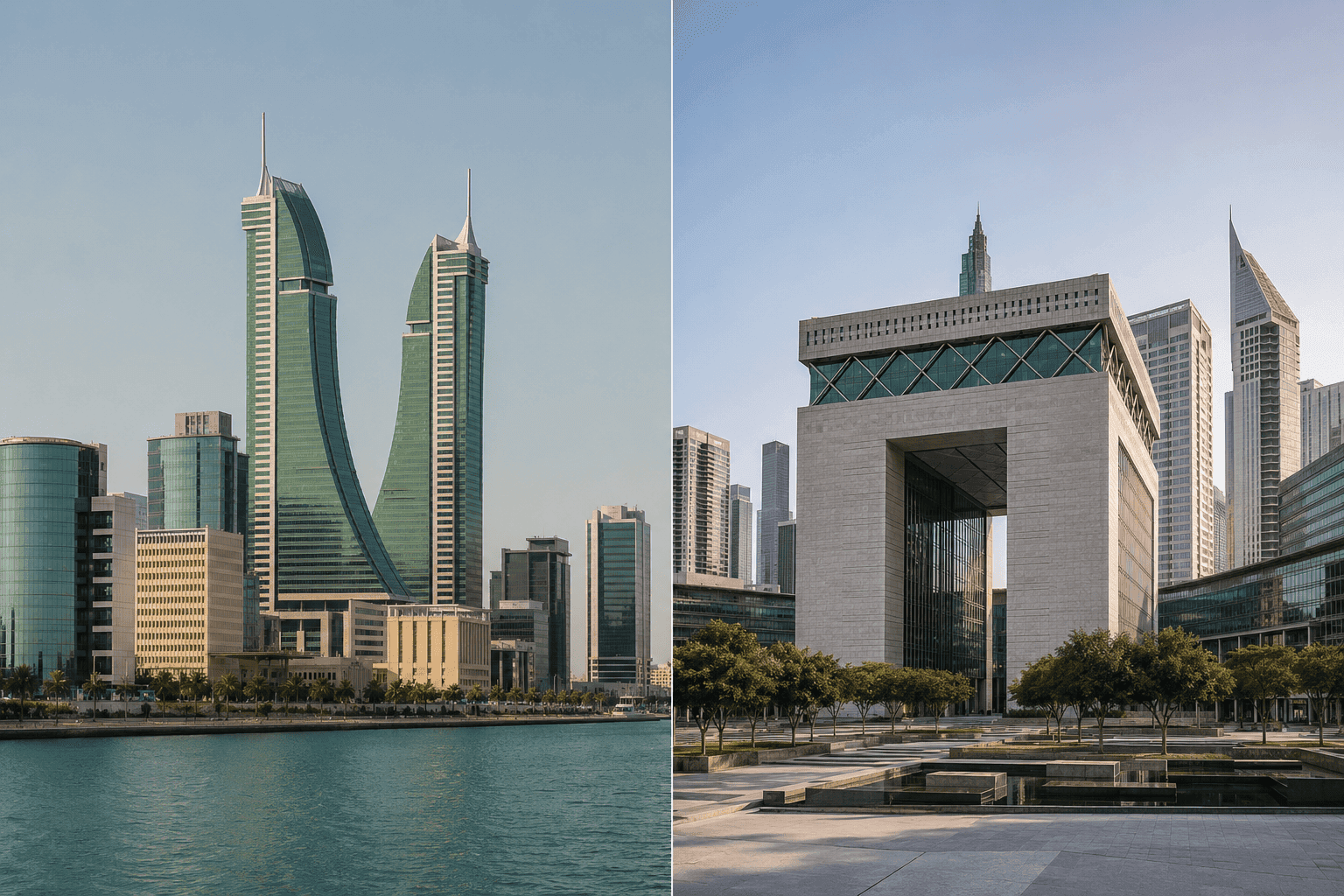
Every year, thousands of international entrepreneurs ask the same question: UAE or Bahrain?
Both are established GCC business centres with zero personal income tax and broad foreign-ownership frameworks. The better choice depends on the activity, target market, scale, licensing route, staffing plan and operating model.
Here is the honest, data-backed comparison , and why we believe Bahrain wins.
Key Takeaways
- The UAE now levies a 9% federal corporate tax on profits above AED 375,000, narrowing the tax-efficiency gap that once made it the default GCC choice over Bahrain.
- Bahrain can offer a lower-cost route for some SMEs, while actual setup and renewal costs in both jurisdictions depend on activity, premises, visa allocation and licensing route.
- Bahrain’s road access to Saudi Arabia and relevant Tamkeen programmes may be useful for qualifying businesses.
- The UAE still holds an edge in certain areas, so the right choice depends on your specific business model, target customers, and growth plans.
The Tax Landscape Has Fundamentally Changed
For years, the UAE’s zero-tax reputation was its most powerful competitive advantage. That story has changed significantly since June 2023.
The UAE applies federal corporate tax under its current rules. The current Small Business Relief regime applies only to eligible tax periods ending on or before 31 December 2026. Businesses should assess the standard UAE corporate-tax rules, exemptions, free-zone provisions and any later relief measures that apply from 2027.
Bahrain currently has no general corporate income tax for most businesses. Oil and gas activities remain subject to sector-specific income tax. A 15% Domestic Minimum Top-Up Tax applies to qualifying multinational groups with consolidated global revenue of at least €750 million in at least two of the preceding four financial years. Bahrain has also referred draft legislation for a broader 10% corporate income tax intended from 2027; the final scope and implementation rules should be confirmed once enacted. Bahrain’s standard VAT rate is 10%, with mandatory registration generally applying from BHD 37,500 in annual taxable supplies.
Any tax comparison must account for deductions, reliefs, free-zone treatment, group rules, sector-specific taxes and Bahrain’s proposed 2027 corporate income tax. A qualified adviser should model the actual structure before a jurisdiction is selected.
Setup Costs: Compare Like for Like
Bahrain may provide a lower-cost setup for some SMEs, but a reliable comparison must define the activity, legal form, premises, professional services, visa allocation, government fees and annual renewals in each jurisdiction. Published package prices are not directly comparable unless they include the same components.
Foreign Ownership: Activity-Specific Rules Apply
Both jurisdictions permit 100% foreign ownership, but the mechanics matter.
Bahrain permits 100% foreign ownership across a wide range of activities. Ownership restrictions, nationality conditions and additional approvals continue to apply to certain regulated, reserved, trading and other activities, so the proposed activity should be checked against the current MOIC rules before incorporation.
The UAE permits 100% foreign ownership in most economic and industrial activities, while licensing and ownership conditions still depend on the activity, emirate and chosen mainland or free-zone route.
For founders who want clean, uncomplicated full ownership without structural workarounds, Bahrain delivers this more straightforwardly.
Banking: More Accessible for Foreign Founders
Both Bahrain and the UAE have established regulated banking sectors. Account approval and timing depend on the bank, ownership structure, activity, source-of-funds evidence and risk profile. In Melqart’s Bahrain experience, a well-prepared application may take around 4 to 8 weeks, but this is not a guaranteed service standard or a direct comparison with UAE approval times.
The Saudi Arabia Connection: An Advantage No Other GCC Country Can Offer
One of Bahrain’s most underappreciated advantages is geography.
Bahrain is the only GCC country connected to Saudi Arabia by road via the King Fahd Causeway. Saudi Arabia is the GCC’s largest economy with a GDP exceeding USD 1 trillion and a population of 36 million people. A Bahrain-based team may be able to reach Saudi Arabia’s Eastern Province by road, but immigration, customs, licensing, tax and cross-border service requirements still apply.
For businesses that want to serve the Saudi market while maintaining a lower-cost operational base, Bahrain’s position is genuinely unique and cannot be replicated from any other GCC jurisdiction.
FinTech and Digital Economy: Bahrain Leads the Region
If your business operates in financial technology, digital assets, payments, or regulated financial services, Bahrain has built one of the most progressive regulatory environments in the world for these sectors.
The Central Bank of Bahrain operates a 12-month regulatory sandbox that allows companies to test regulated financial products with real customers before committing to a full licence. Specific frameworks are in place for crowdfunding platforms, crypto-asset service providers, and open banking, giving these businesses regulatory clarity from day one.
The UAE has strong FinTech infrastructure through DIFC and ADGM, but access to these premium regulated environments comes at a significantly higher cost. Bahrain and the UAE offer different regulatory ecosystems. Cost and suitability depend on the specific licence, regulator and operating model.
Pro Tip
Don’t compare Bahrain and the UAE on headline tax rates alone. Factor in setup costs, banking accessibility, and government support programmes like Tamkeen — together, these often matter more to the total cost of doing business than the corporate tax rate itself.
Tamkeen: The Advantage That Changes Everything
This is the section that surprises most international entrepreneurs, because almost nobody outside Bahrain discusses it with the attention it deserves.
Tamkeen is a Bahraini public authority established in 2006 to support private-sector development. Its programmes, eligibility rules, funding availability and beneficiary categories change over time and should be checked directly before relying on a particular form of support.
Tamkeen offers a range of support programmes. An active Bahrain CR may allow an enterprise to apply, subject to the programme’s current eligibility criteria, beneficiary category, documentation, approval and available funding.
Employment Support — The National Employment Program
The National Employment Program incentivises private sector enterprises to hire Bahraini talent by subsidising a significant portion of employee wages for up to five years. Enterprises can choose from three support structures:
Option one provides wage support for three years, with 70% support in year one, 50% in year two, and 30% in year three, front-loaded to make the initial hiring cost as low as possible.
Option two provides a flat 50% wage support across three years, predictable and easy to budget for.
Option three provides 30% wage support spread across five years, suited to businesses planning longer-term workforce development.
Specialist tracks also exist for engineers, doctors and dentists, actuaries, and people with determination, each with tailored support rates.
For illustration only, a BHD 500 monthly salary under a 70% first-year support track would imply BHD 350 of support per month. Actual support is subject to the applicable wage-support cap, beneficiary eligibility, programme terms, approval and available funding.
Enterprise Support — Digital, Growth, and Funding Programmes
Beyond employment, Tamkeen runs a suite of programmes to help businesses grow and scale.
The Digital Enablement Program supports small and medium enterprises in adopting digital tools and driving digital transformation, covering approved software, platforms, and technology solutions.
The Riyada Business Accelerator Program supports entrepreneurs and startups with structured acceleration, mentorship, and business development resources.
The Business Franchising Program supports businesses looking to grow through franchise models, both acquiring franchises and building their own.
The SME Fund provides subsidised financing through partner banks, improving access to capital for businesses at every stage of growth.
What This Means for Your Business
An active Bahrain CR may allow an enterprise to apply for relevant Tamkeen programmes, subject to the programme’s current eligibility criteria, beneficiary category, wage caps, documentation, approval and available funding. Melqart can help clients identify potentially relevant programmes and prepare an application, but approval rests with Tamkeen.
Bahrain may suit cost-sensitive SMEs and Saudi-facing operations, while the UAE may suit businesses prioritising market scale, global connectivity, specialist free zones or Dubai and Abu Dhabi positioning.
A Balanced View: Where the UAE Has the Edge
Intellectual honesty matters in advisory work. There are specific scenarios where the UAE remains the stronger choice.
The UAE’s local consumer market of approximately 10 million people is significantly larger than Bahrain’s 1.5 million. If your business model depends on local retail footfall or B2C consumer volume, the UAE offers greater immediate scale.
Dubai carries stronger global brand recognition as a business address for certain audiences, luxury goods, global financial services, and large-scale events are sectors where a Dubai presence may carry more prestige with international counterparts.
And for businesses that specifically require access to Dubai’s world-class logistics infrastructure, the largest re-export hub in the region, proximity to Jebel Ali and DP World has genuine operational value.
The right jurisdiction depends on the business case. Bahrain may suit cost-sensitive SMEs and Saudi-facing operations; the UAE may suit businesses prioritising scale, connectivity, market size, specialist free zones or Dubai and Abu Dhabi positioning.
The Verdict
The UAE built its reputation on being the GCC’s most open and accessible business destination. That reputation remains well-earned for specific use cases. But Bahrain has spent the last decade building a quietly superior proposition for a growing segment of international business, one that prioritises tax efficiency, lower operating costs, progressive regulation, direct government financial support, and frictionless access to the Saudi market.
If you are a startup, SME, professional services firm, FinTech company, holding company, or international business targeting GCC markets, Bahrain deserves to be your first choice in 2026, not your second.
Frequently Asked Questions
Is Bahrain cheaper than the UAE for company setup?
Bahrain may be less expensive for some structures, but the comparison depends on the activity, premises, visa allocation, professional services, emirate or free zone, and annual renewal requirements.
Does the UAE still have a tax advantage over Bahrain?
The advantage has narrowed significantly. Since June 2023, the UAE levies a 9% federal corporate tax on profits exceeding AED 375,000, which reduces the gap that previously favored the UAE.
Do both Bahrain and the UAE allow 100% foreign ownership?
Yes, both jurisdictions offer 100% foreign ownership for most activities, though the process is often considered simpler in Bahrain.
Is the UAE ever the better choice over Bahrain?
Yes, for certain business models, target markets, and growth plans the UAE retains distinct advantages, so the right jurisdiction depends on your specific circumstances rather than a one-size-fits-all answer.
Ready to Set Up Your Business in Bahrain?
At Melqart Consulting, we have guided hundreds of international entrepreneurs and businesses through the Bahrain company formation process. We handle everything, from initial structure advice and KYC preparation to your Active Business Licence, corporate bank account opening, and Tamkeen programme applications.
Book a free, no-obligation consultation with our team today. No jargon, no pressure, just clear, expert guidance tailored to your situation.
Visit melqart.co | Email info@melqart.co | Call +973 66370888
Melqart Consulting, Diplomatic Area, Manama, Bahrain. Sunday to Thursday, 9:00 AM – 6:00 PM.
